
The graphs below are based on Providence residents’ responses to our Community Noise Survey. To view both real-time and historical data on daily sound levels around the city that prompt the survey responses, visit our noise-monitoring pages.
- Providence residents’ personal experience of excessive noise in the city
- When and how PVD residents try to adapt to noise around their homes
- How and when PVD residents seek the city’s help to reduce noise levels
- Does seeking help work / how residents think PVD should address noise
1. Providence Residents’ Experience of Excessive Noise

GRAPH NARRATIVES: Four out of five Providence residents who took the survey reported noticing noise on a recurring basis (i.e., not simply getting used to it). Significantly, nearly half report frequent sleep disruption — a major health threat — from noise, and another third are awoken by it at least sometimes. And more than 90% of participants report recurrent exposure to at least one source of vehicle noise (and usually more than one), making motor vehicles the single most-prevalent source of noise in the city.1
2. How Providence Residents Try to Adapt to Excessive Noise
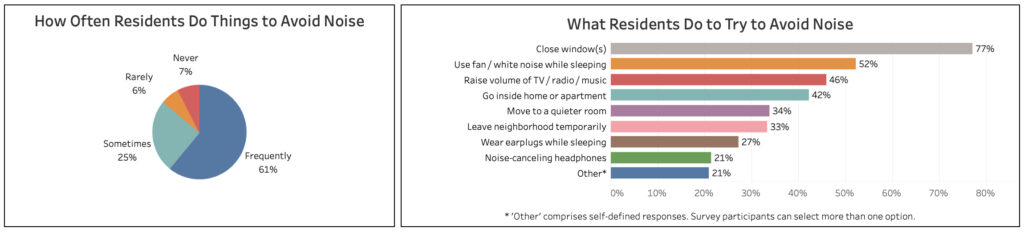
GRAPH NARRATIVES: An overwhelming majority of Providence residents (86%) take personal actions to try to avoid excessive noise before reporting it to the city, with nearly two-thirds saying they must frequently adapt their behavior to avoid noise. Over 75% close their windows and nearly half go inside their homes — which, due to increasing intervals of extreme summer heat, means they either have to pay exorbitant electricity bills to run air-conditioners or fans, or simply swelter indoors, which can be dangerous. More than half report having to run a fan or other “white noise” in order to sleep (even in the Fall and Winter), and one-third are forced to either move to another room (temporarily or relocating their bed) and / or even leave their homes to avoid noise.
3. When and How Residents Seek the City’s Help to Reduce Noise
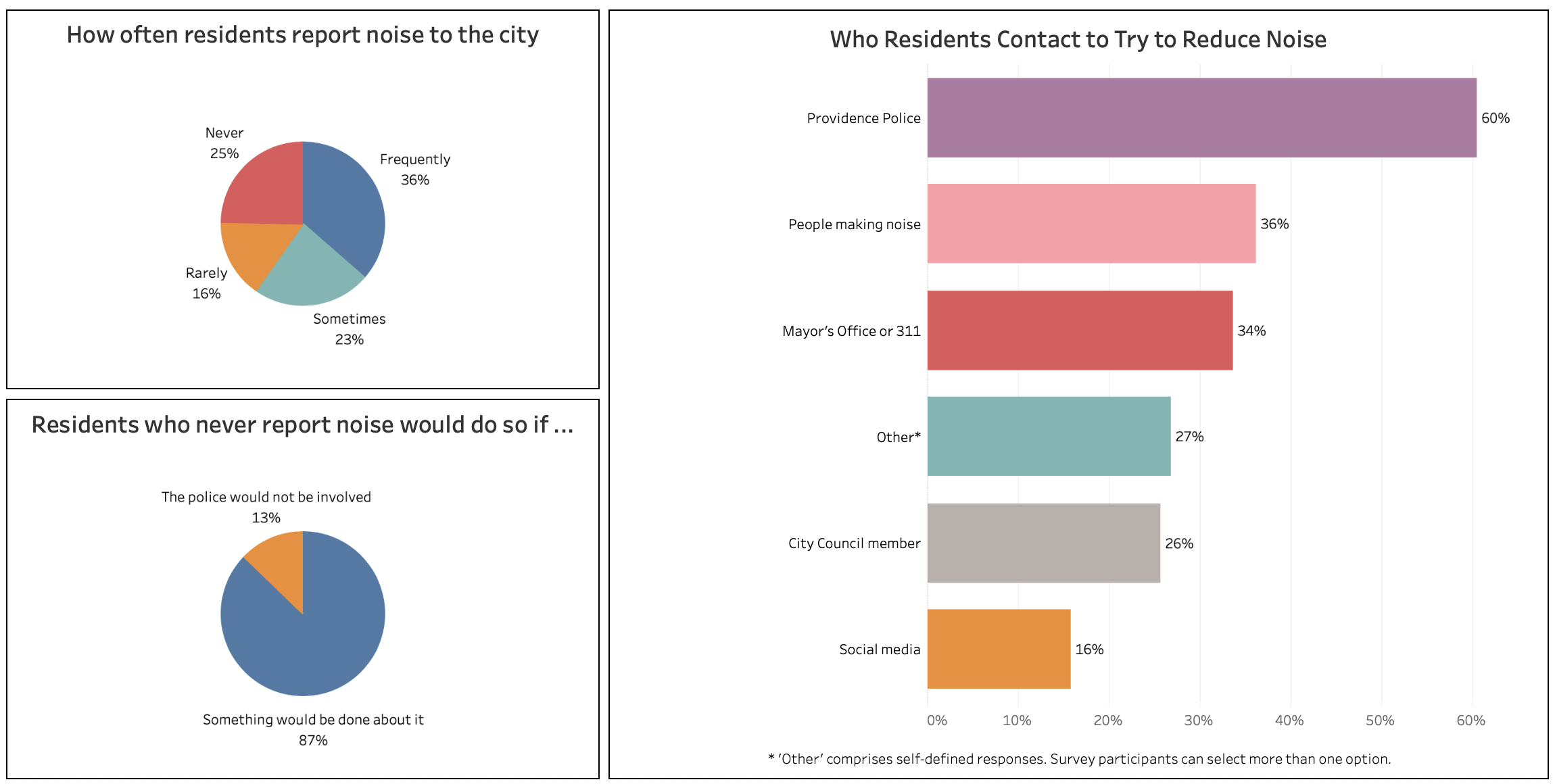
GRAPH NARRATIVES: Providence residents’ personal actions (described in section 2 above) are often insufficient to avoid prolonged exposure to excessive noise, as indicated by the fact that 75% say they report noise to the city at least sometimes — and 59% do so more frequently — primarily by calling the police (as the city tells them to do). More than one-third of residents risk a potentially violent confrontation by asking those responsible for noise not to be so loud. Only contact 25% contact their City Council member, which says something about the efficacy of their elected representatives.
Perhaps most damning is that 87% of Providence residents who currently don’t report noise say they would do so if they knew something would be done about it. In other words, their reticence to report noise isn’t because they oppose enforcement of noise laws, but the contrary — they want the PVD to actually take enforcement seriously. If those residents felt the city would respond effectively to noise complaints, it would push the proportion of those reporting noise to a staggering 96%.
4. Results of Reporting Noise / What Residents Think PVD Should Do About it
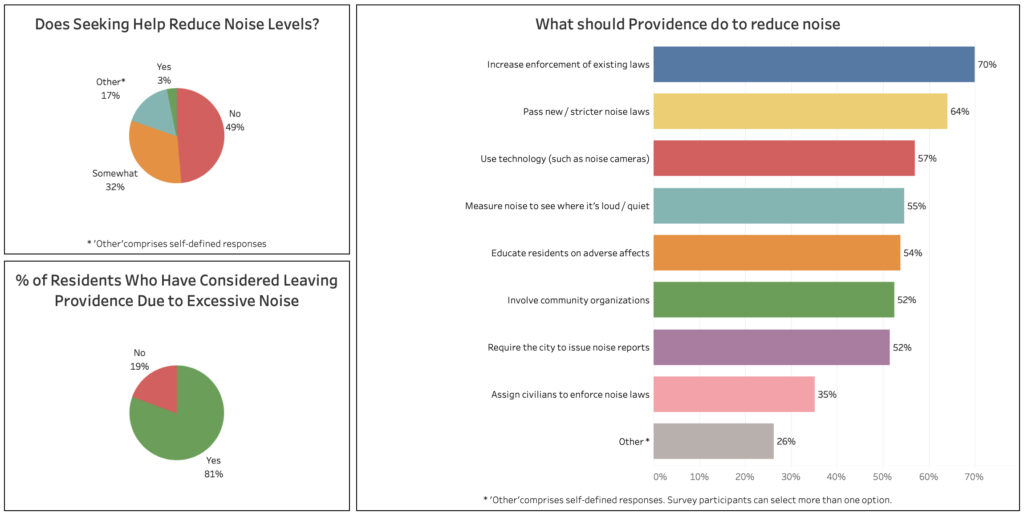
GRAPH NARRATIVES: Only 35% of Providence residents say contacting the city leads to less noise — half say there’s no obvious effect from doing so. Not surprisingly, four out of five have considered moving out of the city due to excessive noise. More than two-thirds of residents say the city needs to increase enforcement of existing noise limits, and nearly as many want noise ordinances to be stricter and more comprehensive.
More than half of Providence residents support technological enforcement such as noise cameras, want the city to monitor noise levels on an ongoing basis, think PVD should conduct a public education campaign to inform residents about the adverse health effect of noise, and issue regular reports on noise levels. (Mayor Smiley endorsed the last three policies as a candidate, but never implemented them after he was elected.)
_______________________
1 Graph labels: “Music from vehicles” refers to over-amplified mobile sound systems. “Loud exhausts” refers to any vehicle (including motorcycles / ATVs) with non-compliant mufflers. “Music from houses” refers to over-amplified sound systems at residences. “Commercial trucks” refers to garbage trucks, cargo trucks, etc. “Stopped vehicle horns” refers to vehicles using their horns while not driving (e.g., to summon people from buildings). “Emergency vehicles” refers to police car, fire truck, and ambulance sirens. “Music from venues” refers to over-amplified music from commercial establishments such as licensed bars, clubs, and restaurants. The survey question also includes an “Other” option, where residents can define additional sources of noise they’re exposed to — each of which is <1% of all responses. The proposed deployment of noise cameras in Providence would address the two most frequently cited sources of noise — over-amplified stereos and modified mufflers — indicated by the two disproportionately tall vertical bars on the left of the Sources of Noise graph.